One of the features in the new Lightroom 3 is a much-improved noise reduction algorithm. Lightroom 2’s version, to be blunt, sucked. It helped, to be sure, if you had nothing, and for minor adjustments it was okay. But when you started throwing ISO 3200 images at it, things degraded quickly, and you were pretty much assured of needing to use a third-party noise-reduction plugin (many of which are very good).
So when I upgraded to Lr3, I had to try the new noise-reduction, and frankly, was blown away. There are situations where the third-party plugins are better, but Lr3 is more than up to the task, as you’ll see in this post.
Note: Because Lightroom is non-destructive, and because noise-reduction algorithms tend to take some time to process, I find that Lr3 gets really, really fussy when you’ve turned the NR on beyond a few percent. Best to disable it if you’re doing other things, or you’re going to start tapping fingers on the desk really quickly. A few other features easily induce this behaviour as well (like distortion correction), so it’s not limited only to NR, but something I thought I’d pass on.

Showing posts with label photos. Show all posts
Showing posts with label photos. Show all posts

The Day the ISO Went Berserk...
(With apologies to Ray Stevens fans, but the title is the furthest my creativity goes tonight.)
It was evening. The sun was getting low in the sky, and the light was quickly fading from the landscape. But the animals were out and about enjoying the fresh air, and me? I wanted some pictures! I had, after all, just bought a new lens for my recently purchased Olympus E-P1, and needed to play!
The lens happened to be the Panasonic 45-200 f/4 – f/5.6 m4/3rds lens, which you can get online for around $270. It happens to be a pretty good lens, too, though it can’t match my Canon EF 70-200 f/4 IS USM lens for image quality and sharpness. But it doesn’t have to – it’s lighter, smaller, and sometimes that’s just what one wants.
It was evening. The sun was getting low in the sky, and the light was quickly fading from the landscape. But the animals were out and about enjoying the fresh air, and me? I wanted some pictures! I had, after all, just bought a new lens for my recently purchased Olympus E-P1, and needed to play!
The lens happened to be the Panasonic 45-200 f/4 – f/5.6 m4/3rds lens, which you can get online for around $270. It happens to be a pretty good lens, too, though it can’t match my Canon EF 70-200 f/4 IS USM lens for image quality and sharpness. But it doesn’t have to – it’s lighter, smaller, and sometimes that’s just what one wants.
Trek in a Cemetery
Okay, so this isn’t usually the place that most people go for pictures. But, for some reason, I like cemeteries, and today was a gloomy but warm day, and I just had to go wandering through a cemetery before I did other various errands. These were all taken with my Lensbaby Composer at f/2 using the double-glass optic.

Praying Statue
More LensBaby Fun
I’ve stated in several places that I absolutely adore my EF 24-70 f/2.8L USM and my EF 70-200 f/4L IS USM lenses, and that my 50 f/1.8 is wickedly sharp, especially considering the price ($100). All of these lenses produce excellent color, sharpness, and contrast. And yet, I’ve fallen in love with another lens: my new LensBaby. This lens isn’t about sharpness, saturation, or contrast – at least not in the ways we think of now-a-days.
I’ve posted the results of my first experiments, and in that vein, here are some more results of experimentation. For all of these images, I used the double-glass optics with an aperture of f/2.

I’ve posted the results of my first experiments, and in that vein, here are some more results of experimentation. For all of these images, I used the double-glass optics with an aperture of f/2.
Behind the Curtain
Lensbaby Composer
Note: Reposted because of a trigger-happy finger and a delete button. D'oh!

The LensBaby Composer is the third iteration of the LensBaby concept – a lens that you can tilt to achieve all sorts of creative effects. You can drop in different optics – from double-glass optics (relatively sharp), to plastic optics (think lomo), and even pinhole or fisheye optics. Needless to say the variation you can get out of this is amazing, as long as you’re willing to experiment.
I bought my Composer on Saturday, and so I haven’t had a lot of time to play, but of course, it was a new toy, so I had to play a bit. It was really cold & windy outside, so instead I coerced my puppy stuffed animal to pose for me:

The LensBaby Composer is the third iteration of the LensBaby concept – a lens that you can tilt to achieve all sorts of creative effects. You can drop in different optics – from double-glass optics (relatively sharp), to plastic optics (think lomo), and even pinhole or fisheye optics. Needless to say the variation you can get out of this is amazing, as long as you’re willing to experiment.
I bought my Composer on Saturday, and so I haven’t had a lot of time to play, but of course, it was a new toy, so I had to play a bit. It was really cold & windy outside, so instead I coerced my puppy stuffed animal to pose for me:
%5B13%5D.jpg "Lensbaby Meets Stuffed Animal")
Pose #1 (Double-glass Optics, f/2, 1/125, ISO 100)
Stop! Don’t Delete That Picture!
Here’s a quick & dirty reason why you shouldn’t just delete pictures – at least not before you’ve given some thought as to how you could salvage them:

First off, let me say this: isn’t this little guy adorable? And yet the picture is obviously a “mistake” – accidentally taken with far too long an exposure, blurred, moving, etc.
My first instinct was to delete the picture.
Then a thought flitted into my head… “maybe I can do something interesting with it…”
And so I tried, and here’s the result:

I don’t know about you, but I think it was one of the best from the shoot. There’s just something so… beautiful… innocent… intangible about the image that I have fallen in love with it.
And, it was a perfect example for this quick lesson: before you delete a picture, think about what you could do to save it. Unless it’s a picture of the lens cap, chance are you can do something with it!
Until next time, keep writing with light!
Something Different
When a gaggle of geese visits you every few months, you tend to get familiar with them – as much as they will allow, of course. But this year there’s something different in the midst of this gaggle:

“Something Different”
I’m not sure if this is an albino Canada Goose, or if it is a Snow Goose. Either way, it is strange seeing this white goose amongst all the other geese. Even more interesting is that this goose is tolerated in the group.

“Looking for Food”
It’s not obvious from these two images, though, that this bird is injured. This poor thing walks with a limp – not sure if he has a broken or simply malformed leg, but it is painful to watch him try to walk. He gets around enough to eat and such, and his wings look normal, so he can probably fly okay, but still, it is sad to see, especially when he is such a beautiful bird.
The next couple of images have nothing to do with this white goose; just some friendly geese from the same gaggle:

“Taking Flight”
These geese took flight as I was photographing the other white goose. This was the only decent photo I got before they were all behind the tree. The lead goose’s head was, in reality, already behind the leaves, but a little post-processing work, and you get to see the whole thing!

“Enjoying the Evening”
More like “watching me”, but there’s just something pleasant about this goose and the scene. He’s not really that far away from the rest of the geese; but he was on the outer edges of the pack just standing there with his eye on me. After a few more pics, I hurried on to my car – it was cold out! –, but he apparently didn’t mind the temperature. Must be all those feathers!
On a totally different note, I get to go down to St. Louis this weekend and visit family and get to see my two nephews… they are going to be so fun to chase around with my camera!!!! Here’s hoping for some great pics…
The Golden Hour + Lightroom Presets = Really Cool
The Golden Hour is a fantastic time to take pictures – the light is amazing, and you get all these wonderful colors that just don’t happen when the sun is directly above you. But say you took those fantastic pictures and did a bit more with them after the fact?
First off, I love, love, love the Hodda Blue/Yellow split tone (available for free for LightRoom here). The first six in this post all use the preset at some point in their processing (along with the usual adjustment of levels, crops, and any spot removal needed…)
These first three are insect photos that I happen to like a lot. They were taken just before the golden hour really set in, so in reality everything was nice and green --- using the preset here happened to isolate the subject better by turning the green into a more “purple” background. It also gave the images a look not typically seen in nature photography – wherein the colors here aren’t really representative of the real thing.


The images above were taken just prior to the golden hour; the ones that follow were taken right in the midst. Here the split toning makes for some striking images:


The image below didn’t use the blue/yellow preset. Instead it used a lot of presets (including: WOW Gradient P09, Focus > Snow Detail, and Blue/Red Cross), but I like the effect:

And for the final image – sunset with silhouette trees, the image was spectacular without any processing. In fact, I almost let it go online without any processing. And then I got to playing, and when I used the ADB AGFA Cross Process preset, along with some vignettes, and some additional saturation / vibrance adjustments, this came out. I’m in love:

My last post on this blog was about the golden hour, so this makes two in a row about that subject. But it is an important time of day – the colors are just so gorgeous. But even though the image might be perfect before you do any real work on it, don’t let it stop you from trying things out. You might just find an effect you really, really like (like I did).
So, if you have Lightroom, and like to play with presets, here are some great sites to get you going:
- http://www.profiphotos.com/blog/en/category/downloads/
- http://www.ononesoftware.com/detail.php?prodLine_id=33
- http://prophotoshow.net/seim_effects/category/free-lightroom-presets/
- And the mother-load: http://www.prophotoshow.net/blog/2007/11/09/lightroom-presets-the-ultimate-free-list/
Technical Note: all the above except the last image were taken with the Canon EF 24-70mm L USM lens + UV Filter + Circular Polarizer. The final image was taken using the Canon EF 70-200mm L USM IS lens + UV Filter. Neither lens is cheap, but if you shoot Canon and can get either one of these lenses, you won’t regret it. Aside from being great to build arm strength, they deliver fantastic image quality and ease of use. That said, you can get great image quality with less expensive lenses – so don’t let lens-lust stop you.
Oh, and one more final note – if you don’t have a polarizing filter yet, get one. UV filters can be of questionable value, but a polarizer can do things to colors and reflections that would be hard (if not impossible) to duplicate in Photoshop. You can lose 1 – 2 stops of light when using them, but the results are well worth it. (Just don’t get the cheapie $15 ones. Get something that’s in the $50+ range.)
So – until next time, keep writing with light… (especially the golden kind!)
Remains of the Day
Sometimes the best nature pictures can come at the end of the day, when all the day creatures and plants start wrapping up their daily duties and preparing for the oncoming night, and while the nocturnal creatures and plants begin to make plans for the next several hours of darkness.
The remains of the day also happens to give some absolutely fantastic light in which to shoot – warm tones, golden hues – hence the term “golden hour”. And “hour” is about right, give or take a few minutes, depending on the season and where you live.


Even though each of the photos above have been post-processed to evoke a certain mood or feeling, they were all taken within the same one hour span prior to the sun fully setting. That the sun is low in the sky creates dramatic shadows, but at the same time warms the colors significantly. Most photographers are in love with this kind of light, for good reason – it’s beautiful, before and after post-processing gets applied.
You may also notice that in every one of the above shots, I’m shooting towards the sun. You don’t have to do this, obviously, but in the case of the top-left image, doing so created a very strong backlight effect on the plant. It also lent itself well towards the long shadows in the lower two images. Though you can’t really tell it, the sun was behind the silo in the upper-right image, making it really simple to come up with a striking silhouette, and lending a golden hue to the sky.
You can do all sorts of things with the light the golden hour creates. Depending on what you are shooting, though, you may need to increase your ISO, open your aperture, or bring a tripod. The sun may be out, but the amount of light getting into your camera is no where near that generated at high noon. Of course, the reverse can easily apply if you’re aiming directly at the setting sun and aiming to create silhouettes; drop your ISO to 100 and you’ll still have shutter speeds hovering around 1/500 to 1/1600. But for anything more than a silhouette, you’ll need to increase your ISO and open your aperture to let as much light in as possible if you plan on hand-holding (and don’t forget the inverse focal length rule – and having image stabilization really helps here!). If you have a tripod, on the other hand, keep your ISO as low as you can, and set your aperture for your desired effect, and go at it. No matter how you shoot during the golden hour, you’ll have a blast, I guarantee it!
P.S. If you’re not a night owl, but a morning person instead, the same rules apply to the rising sun. You’ll get fantastic golden light with dramatic shadows during the early morning hours. On the other hand, if neither the morning or evening are your cup of tea, you can still make great pictures, but I tell ya – you’re missing something special!
Until next time, keep on writing with light!
Why Your Camera Should Always Be With You
Because you never know what might be around that you’ll think makes a really cool picture. Case in point this little, tiny spider on the windshield of my car, after having gone grocery shopping – I had one chance (the light was about to turn green), and my little point-and-shoot that can do a macro focus at 1cm did the job perfectly. One thing it did pick up a tad too well was the dirt on the windshield – which means my car needs a wash (which it got – see last post).
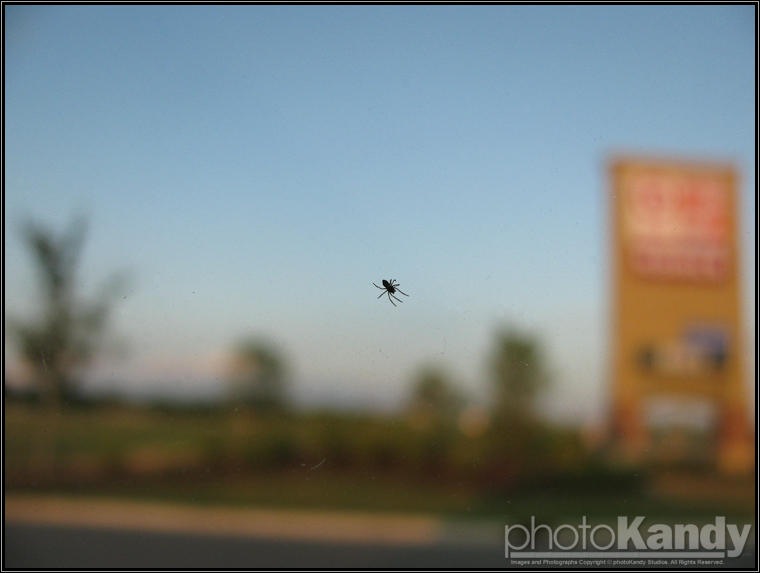
And in case you’re wondering – the spider is on the outside of the car – which is why I could think enough to take the picture. It also helped that he was absolutely tiny (far smaller than this picture lets on). As to his well being after the light turned green, I can’t say – all I know is he was no longer attached to the car after the light turned green. (Poor little guy!)
Look What Happened On The Way Home!
The weather forecast said a slight chance of thunderstorms. Well – it was right! During my drive home, I ran in to this:

Words really do not do the above pic justice, and the pic does not do the actual thing justice. That thing was spinning, I tell you. Granted, it was dying (It didn’t stay this way long), but STILL – it was a very nasty cloud. The rain was on the windshield was from a very heavy downpour seconds before sighting this thing.
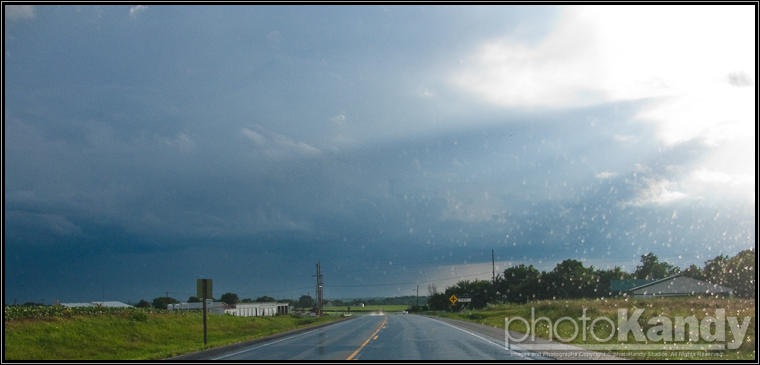
Closer to home, the sun broke out and rendered this fantastic scene, with sun beams breaking through the nasty clouds in the distance. And yes, this after another (of several) downpour – as my windshield reveals.

And this is looking back at the monster storm. Okay – so it wasn’t that big of one – probably wasn’t even indicated severe at any point in its life cycle. But seriously – it wanted to be worse. (And now I’m attributing feelings, motive, and character to a storm. What’s that say about me?)

Another view of the receding storm – you can see some of the high thunderclouds way in the distance. And all that rain? I think my car sure feels like it went through all of it – it definitely got doused enough times to qualify as having a car wash!
Needless to say it was an interesting ride – rain, clouds, sun, rain, clouds, sun, rinse, lather, repeat. I’m just thankful that the storm didn’t have a chance to get nastier, and that it had stopped raining by the time I got home so that I didn’t get drenched!
Beauty All Around
All too often we go through our lives without really stopping to appreciate those things that are around us – even though they may be small things or large things. They might be things we take for granted – like trees or flowers, or even things we find annoying or a bit frightening (like spiders, bees, or other creepy-crawlies). And yet, if we would pause but for a moment, we might just find out that there are truly beautiful things all around us – just waiting to be discovered.
If you are a photographer, chances are you’ve specialized in certain types of photography – like weddings, or sports, or portraits. And if you haven’t – or are discovering your niche – that’s fine too. Regardless of where you are in your photography, I challenge you to take some time and just look around you – you might be very surprised at what appears before your eyes.
Below are some shots taken on a photowalk at a small park in southern Illinois. I never got beyond the entrance – there were simply so many little flowers, bugs, beetles, bees, and dragonflies that were beautiful subjects that I didn’t need to go any further!

I’ve officially been bitten by the love of bumblebees. Not that I’m out to pick one up, mind you, but they are just so difficult to photograph well. The above image is one of my best bumblebees to date, and given the interesting flower he’s on, it makes the image all the better. I shot this with a 50mm lens at f/8 to ensure that I would get both the bee and flower in good focus.

The above image is fairly simple – just some yellow flowers cloistered together. But look at all the detail in each flower – it simply boggles the mind!

Given that there were dragonflies around, well – I just had to try and get some pictures of them. I’m not sure, but they may be harder to get than a bumblebee. Some where quite content to sit on a stem for awhile, but others would land and fly away, barely giving me enough time to catch a shot. The above was one of the latter – he landed on the flower, I took a picture, and he was gone. I will say this: having a nice long lens helps to capture these guys if they are staying still – you’re less likely to spook them when you are four feet away versus being six inches away! (By this shot, I was using my 70-200mm f/4L lens.)
(Side note: from this angle, even f/9 is insufficient to keep the entire dragonfly in focus; only his body and far wings are focused; the wings closer to us are blurry. But had I lingered to stop down the aperture, he’d have disappeared, and the shot would never have occurred.)

The colors in this beetle fascinate me. There are white spots, a bronze back, and a shimmering green head, which, as far as I’m concerned, makes this guy absolutely gorgeous. (And so is the flower, in case it feels left out!)

Simplicity works to your favor too – here the flower is the only thing in focus – everything has been thrown out by using a fairly wide aperture (f/5.6) at a long focal length (200mm), but had the background been closer, it would not have been as out-of-focus. It took some creative framing to get the angle on this guy just right.

It was this flower’s color that attracted me at once – the yellows, pinks and magentas are absolutely stunning. A smaller aperture (f/8) ensured that a good portion of the flower was in relative focus; f/4 would have resulted in a much blurrier flower. As it is, if you look closely, you’ll notice that the focal area doesn’t go much beyond the stamens and a bit of the petals. Even so, I like it.

I’d spotted bumblebees doing this earlier in the photowalk – and then I wanted to capture one actually doing this – exiting a flower after collecting some pollen. I waited and waited and waited (well – I took pictures and took more pictures, and yet more pictures), and finally caught this guy at just the right moment crawling out of the flower. There’s something cute and fuzzy about him, no? (He might disagree… having a stinger and all!)

More often than not, the dragonflies would land on sticks instead of flowers – but they still produced interesting shots. I was back at f/8 to ensure that most of the dragonfly would be in focus, but what really drew me to this particular shot was the way the setting sun was reflecting off his wings – the colors in there are gorgeous.

These wispy plants just go to show that even the most ordinary looking thing can be gorgeous when the right light is around. Having got down at just the right angle, the sunlight hitting these plants was absolutely wonderful. Look closely – there’s an astounding amount of colors there.
Beauty doesn’t have to be found in nature, either – just look around your home – there are bound to be fantastic opportunities for creative shots there as well. If you have pets, then opportunities abound, but even the ordinary can be turned extraordinary with a creative angle and creative lighting.
You can see all the processed images taken at this park here, or you can click on any of the images above for a larger view.
Until next time,
Keep Writing with Light!
Stormy Days
I happen to like storms. I don’t know why – I just always have. Maybe it’s because I feed, somehow, off of the electricity in the air, or am excited at the prospect of watching something absolutely awe-inspiring and terrifying, with powers on display far greater than my own. Who knows. I’m weird like that.
So, on Friday, we had a whopper of a storm cell move through. I was fortunate enough to catch a couple shots of some thunderclouds in the distance, as well as those boiling (yes, I mean boiling) overhead, and then some shots once I got home. So without further ado, here’s some of the shots from the storm:

Storm clouds in the distance; power lines in front. I don’t think my city ever lost power, but I bet someone did…

Thunderhead up close and personal. Except, he’s actually several miles away – closer to Aurora, IL. The shape, however, was what most intrigued me – hence the shot.
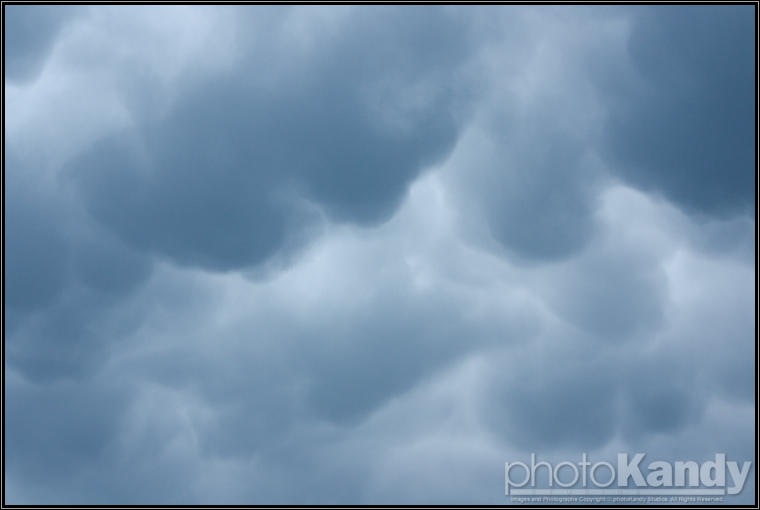
And this – this was what was boiling directly above me. Yeah – fun stuff! At this point, though – no rain yet. I didn’t begin to see any lightning until I hopped back in my car and continued on down the road a while. Even so, I didn’t take a million pictures of this stuff. Better safe than sorry, right?

The view out my car as I pull into town. Rain, rain, rain, rain. Everywhere rain. And the wind. Goodness-gracious-me. At this point we were under a Severe Thunderstorm Warning – mostly for the wind gusts – which were, in some areas, over 60 mph. I don’t know that it was that bad in town, but leaves and other debris was definitely flying around, so it was strong, regardless.
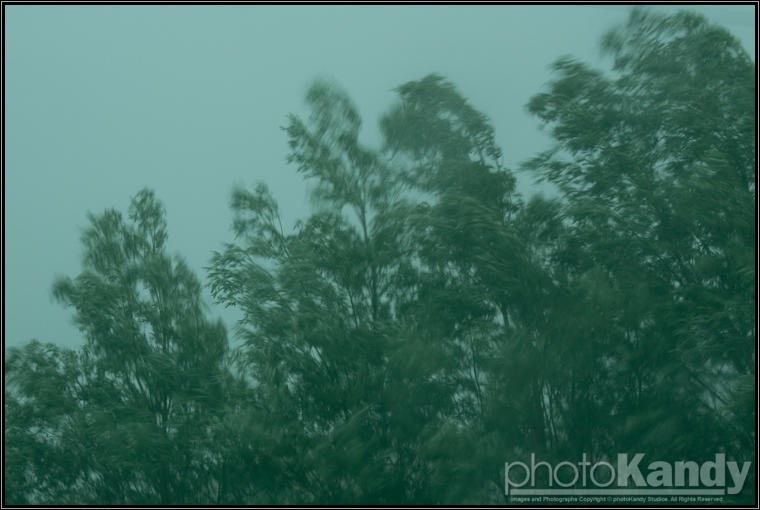
After I parked in front of my apartment, it was pouring torrents and torrents of rain. So, to wait a little while in the hopes that it would slow down a bit, I snapped some shots out the car window. This was a clear one with a slow shutter speed so that the movement of the trees in the wind can be seen very clearly. This was probably the height of the wind part of the storm as these poor things were going all over the place.
Needless to say, I finally made it back into my apartment (else I couldn’t have processed these images), but it was quite the nasty storm cell. It went on to do quite a bit of damage closer to Chicago, from what I heard on the news, which just goes to say how dangerous these severe weather events can be. And how lucky I was to have made it close to home before really getting pounded by the wind and the rain!
Pictures Everywhere
Even in the most innocuous of places there is a world of pictures just waiting to be taken. This is why it is so important to take your camera (or one of them, at least) with you all the time – there’s undoubtedly a picture waiting for you around the next bend, in the next room, or waiting to pop out at you five minutes from now.
Case in point: my recent stay in a hotel. It was late at night – after 9pm, and I was bored watching the TV. So as I wandered around the room, I discovered a plethora of interesting angles and objects. Here’s just a few:

An interesting angle from the bedroom into the living area and the door of the suite.

The reflection of my bed (prior to having been slept in, obviously) in the bedroom television screen. I think it gives it a rather lo-mo effect, even before the post-processing was applied.

This is just a lamp. But aren’t the textures on it gorgeous?

These happen to be my shoes. Not sure why, but they looked an interesting target for my camera!
So, even though it was late and I was in an unfamiliar place – there were pictures to be taken. I could easily have missed these (and others) had I not had a camera with me, or an eye for trying things. I’m so glad I had both with me – my camera, and my eyes – and I’m ever-so-pleased with the results.
Here’s the moral of the story, I suppose: have your camera with you, and experiment. You never know what you’ll capture! Until next post, keep on writing with light!
P.S. The above happened to be a wonderful reason to have some fast glass on your camera. I have the wonderful Canon 50mm f/1.8 II lens which, aside from being cheap ($80), is also sharp and faster than any of my other glass (f/3.5 and f/4). While the room appeared bright to my eyes – it was nothing compared to sunlight – so most of the images above were taken at ISO 800 with exposure times between 1/40 and 1/80 second. If you don’t have fast glass, but have image stabilization, you should be able to achieve similar results.
P.P.S. One more footnote: this also happens to be a really good reason to have a dSLR or a compact with a large sensor size. ISO 800 returned eminently usable results, but on a smaller sensor, the images would be gritty, full of noise, and lacking in detail. Take the noise you do see in the images above and multiply it by a few times to get a good image of what they would look like on a small point-and-shoot with a small sensor. That’s not to say you can’t get great results with a small sensor, just that it takes more work to do – and you probably won’t be shooting at ISO 800, either.
Subscribe to:
Posts (Atom)